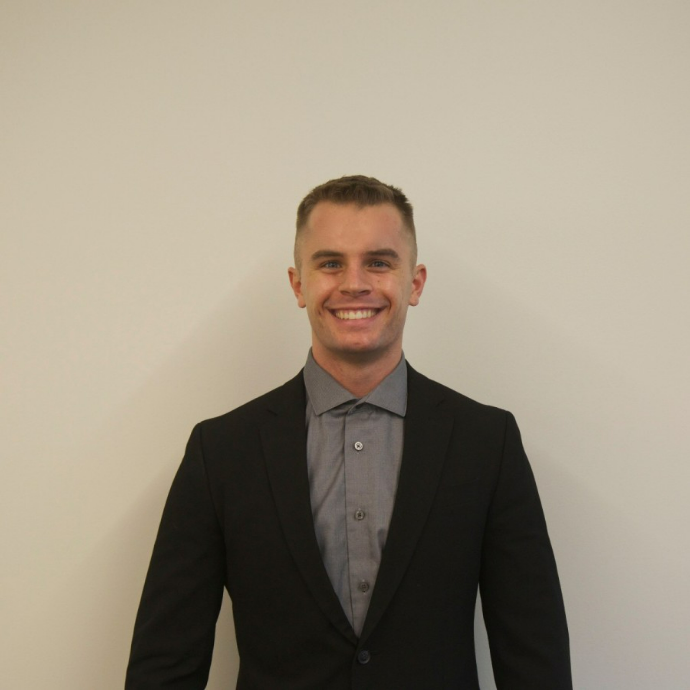
Chad Cheldelin is a BSN student and one of the center’s 2025–2026 Healthy Aging Undergraduate Research Scholars. His faculty mentor is Kendra Kamp, and his scholarship project is titled, “Influence of Delirium on Health Outcomes in the Postoperative Period Following Ostomy Surgery.”
Why did you choose nursing?
I’ve worked in healthcare for about five years prior to starting nursing school. I worked during the pandemic in a rural, underserved area. My goal is to finish my BSN, then go on to get a nurse practitioner degree and eventually go back home to serve an underserved population.
I felt like nursing was a good route for me to be able to give back, especially because there’s a large need for healthcare providers.
You mentioned you worked in healthcare before this. What was your past healthcare experience like?
I have about three years of healthcare experience in medical assisting. Two of the years were in an urgent care setting, where a lot of people using these services don’t have the best access to healthcare services.
One of the years, I did primary care medical assisting, and I helped with the transition to a larger healthcare corporation from a small family-owned business. It was a lot of work to update patients’ charts and ensure that they’re still getting seen and getting high-quality care. I had a passion for helping the people who were subject to the healthcare changes going on.
What interests you about healthy aging in general?
When I was working in the primary care setting, we saw a lot of routine colonoscopies. I saw that the recommendation was becoming earlier for colonoscopies because the prevalence of colon cancer is going up among younger people. I’m interested in screening techniques to help reduce the incidence of colon cancer, which is primarily in the older population, but it’s becoming more common in the younger population.
What made you interested in doing a research project during your BSN?
I’m most interested in the research process and seeing the type of research that goes into establishing healthcare information, and I think it would help me in a nurse practitioner program to be able to sift through and learn from the literature.
Could you briefly describe what you’re doing for your de Tornyay Center research project?
Our research is looking at delirium in the postoperative period for patients undergoing ostomy construction surgery. Ostomy construction surgery is a gastrointestinal surgery where a section of the GI tract is diverted through the abdominal wall to an opening created to outside of the body called a stoma. Intestinal contents are collected in an ostomy pouch attached around the stoma.
We’re looking at how the prevalence of delirium in the postoperative period relates to anxiety, sleep disturbance, depression, pain and fatigue. We’re seeing how those are correlated to delirium in the postoperative period.
There’s a lot of postoperative delirium studies for other types of surgeries, but not as many for ostomy specifically.
What interested you about this project?
This research project will help me know how to treat patients after getting ostomy surgeries and know what kind of side effects to look out for that could affect patient outcomes.
Why is the research that you’re working on important to do?
I think this has the potential to help patients by showing me, or other people who see this research, what to look out for when someone gets ostomy surgery and to know what predisposes them to poor patient outcomes.
Since we found significant findings, it seems that delirium is connected to some side effects that could affect their care. After surgery is a crucial moment to make sure that we’re treating them so that they’re less likely to have delirium.
You mentioned that delirium may come with side effects to their care. Do you have any sort of examples of what that might look like?
We found that the patients who had delirium were more likely to have anxiety and depression, more sleep disturbances and fatigue. We can’t say it’s causation, we just found that they tended to occur together.
Is there anything else that you want to share?
It was a really good experience to work with my mentor’s colleagues at the Mayo Clinic for this project. It helped us know more about the processes that are involved in conducting research and it was really cool to see the clinical component of research as well.