The University of Washington School of Nursing recently welcomed a sold-out audience of nurses, researchers, health system leaders, educators, students and technology innovators to the inaugural RAIN Summit: Reimagining AI in Nursing and Health Care. Held May 15 at the UW Center for Urban Horticulture, the summit positioned nursing at the center of one of the most important conversations shaping the future of healthcare: how artificial intelligence can be responsibly integrated into clinical care, workforce development, education and health system operations.
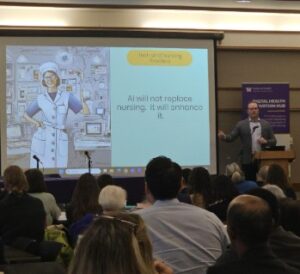 Hosted by the UW School of Nursing’s Office for Nursing Research & Innovation (ONR&I), the Digital Health Innovation Hub (DHIH) and the Washington HIMSS Chapter, the summit brought together nationally recognized leaders from across nursing, industry, policy and digital health to move beyond hype and focus on practical implementation and responsible innovation.
 “The energy in the room was incredible,” said Allison Webel, Associate Dean for Research and Innovation at the UW School of Nursing. “This summit demonstrated that nurses are not just adapting to AI, they are helping lead how it is designed, implemented and evaluated in real-world care settings.”
The day featured keynote presentations and panels from leaders including Dan Weberg and Tom Lawry in the opening keynote, Ryan Shaw from Duke, Perry Gee from Intermountain Health, Jennifer Mensik Kennedy from ANA and panels including leaders from UPenn, Vanderbilt, Columbia, PeaceHealth, Harborview, Providence Swedish, the Washington State Nurses Association and Joint Commission. Discussions focused on AI governance, workforce readiness, nursing education, ethical implementation and preserving clinical judgment in increasingly technology-enabled environments.
“This was intentionally designed as a practical and collaborative summit,” said Oleg Zaslavsky, Director of the Digital Health Innovation Hub. “We wanted to create a space where health systems, educators, policy leaders, frontline nurses and technology experts could have honest conversations about what responsible AI implementation actually looks like.”
The summit also highlighted UW’s growing leadership in digital health innovation and interdisciplinary collaboration. Through student ambassador programs, mentorship opportunities and cross-sector engagement, RAIN emphasized preparing the next generation of nurses to lead in a rapidly evolving healthcare landscape.
Participants repeatedly highlighted the summit’s emphasis on balancing innovation with trust, transparency and patient-centered care. As AI adoption accelerates nationally, RAIN reinforced a central message echoed throughout the day: nursing perspectives must remain essential in shaping the future of healthcare technology.