
First-time NCLEX
pass rate
Hours of hands-on
patient care
of your clinical placements
are arranged by the UW School of Nursing
Back-to-back quarters, full-time
Ready to make the move into nursing?
If you already hold a bachelor’s degree in another field and are ready to move into nursing, the UW Accelerated Bachelor of Science in Nursing (ABSN) offers an intensive, 12-month route to a nursing degree.
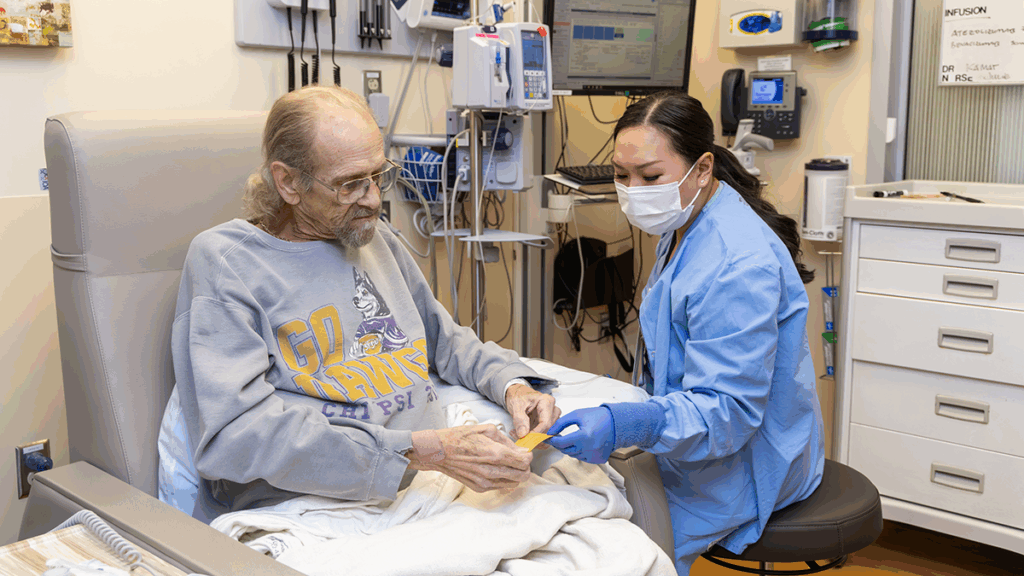
You’ll spend four full-time, back-to-back quarters moving between the classroom, our INACSL-endorsed Simulation Center and more than 600 hours of direct patient care. Clinical rotations draw from a network that includes Harborview Medical Center, the only Level I trauma center serving a five-state region, plus UW Medical Center, Overlake Medical Center, Providence Regional Medical Center Everett, Seattle Children’s and Swedish Medical Center.
Next application deadline
Aug 2026
Oct 15, 2026
Dec 2026
Have a question?
Join an information session
Request more information
asknursing@uw.edu
What makes our ABSN program different?
Hands-on training, coordinated clinical placements and one program tuition rate regardless of residency set the UW Accelerated BSN program apart.
Two starts per year

One application, two possible start dates. Spring and autumn cohorts mean you don’t wait a year to begin your career change.
We coordinate your clinical placements

The Office of Clinical Placements arranges every rotation, so you can focus on learning rather than finding your own clinical sites.
Built for career changers, open nationwide

Fee-based tuition means students pay the same program rate regardless of residency, with no out-of-state premium.
Your ABSN, quarter by quarter
Four back-to-back quarters, moving from nursing science foundations to a full-time clinical practicum.
What to know before you apply
The ABSN is a full-time, in-person program completed over four consecutive quarters, beginning in spring or autumn. It is not offered as an online or distance-learning program.
You’ll learn through classroom instruction, simulation and supervised patient care. After graduation, you’ll be prepared to take the NCLEX-RN examination and pursue licensure as a registered nurse. The program also provides a foundation for future careers in research, administration and education or for graduate nursing study.
Both programs lead to a Bachelor of Science in Nursing degree. The primary differences are the pace, schedule and tuition structure.
The Accelerated BSN is designed for students who already hold a bachelor’s degree in another field and are prepared to complete an intensive program over four consecutive quarters. The BSN follows a two-year schedule after students complete the required college-level coursework.
For eligible postbaccalaureate applicants, the right choice depends on your preferred pace, financial considerations and ability to commit to an accelerated program.
The Accelerated BSN prepares you to:
- Integrate concepts from the arts and sciences in promoting health and managing complex nursing care situations.
- Apply leadership concepts, skills and decision-making in the provision and oversight of nursing practice in a variety of settings.
- Translate principles of patient safety and quality improvement into the delivery of high-quality care.
- Appraise, critically summarize and translate current evidence into nursing practice.
- Integrate knowledge, processes and skills from nursing science, information and patient care technologies and communication tools to facilitate clinical decision-making and the delivery of safe and effective nursing care.
- Describe the effects of health policy, economic, legal, political and socio-cultural factors on the delivery of and advocacy for equitable healthcare.
- Demonstrate effective professional communication and collaboration to optimize health outcomes.
- Deliver and advocate for health promotion and disease prevention strategies at the individual, family, community and population levels.
- Demonstrate value-based professional behaviors that integrate altruism, autonomy, integrity, social justice and respect for diversity and human dignity.
- Demonstrate critical thinking, clinical decision-making and psychomotor skills necessary for the delivery of competent, evidence-based, holistic and compassionate care to patients across the lifespan.
- Demonstrate critical interrogation of positionality, recognition of implicit biases, as well as knowledge and application of anti-racism principles to promote health equity.
To be considered for admission, you’ll need:
Academic preparation
- A bachelor’s degree in a non-nursing field completed before the program begins.
- A minimum cumulative GPA of 2.8 across all completed college-level coursework.
- At the time you apply, at least three Natural Sciences prerequisite courses completed with a grade of 3.0 or higher in each course.
- A minimum grade of 3.0 (“B”) in each ABSN prerequisite course, including all Natural Sciences courses, Lifespan Growth and Development and Statistics.
- There is no expiration date for prerequisite courses. You may choose to retake a course if you need a refresher before beginning the program.
Healthcare experience
- At least 100 hours of hands-on healthcare experience completed in one setting within a three-month span during the 12 months before you apply.
- Your experience should be concentrated and supervised, include direct patient contact and give you opportunities to work alongside registered nurses.
- Many applicants complete nursing assistant training or work as nursing assistants before applying, but this is not required. The purpose of the experience is to help you develop a clear understanding of the registered nurse role and explain why nursing is the right fit for you.
Additional requirements
- Meet the Essential Qualifications & Behaviors for Nursing Students.
- Provide proof of English language proficiency, when required.
- Submit a credential evaluation for coursework completed outside the United States, when required.
Questions about your eligibility?
Email asknursing@uw.edu or join an upcoming information session.
Postbaccalaureate admission required
If you are admitted to the ABSN program, you must also submit a separate UW postbaccalaureate application for your assigned start quarter and pay the UW application fee. This process is separate from School of Nursing admission, and admission to the School of Nursing does not guarantee admission to the UW.
Not sure whether a course will meet a prerequisite?
You can use your transcripts and course descriptions to determine whether previous coursework is likely to meet an ABSN prerequisite.
- Start with the UW Equivalency Guide if you attended a Washington state community or technical college.
- If your course is not listed, compare its course description, content and credit hours with the sample UW courses on the ABSN prerequisite worksheet. Sample UW courses are examples; other courses with substantially similar content and credit hours may also meet the requirement.
- Keep course descriptions or syllabi for courses that may need additional review, particularly courses that are no longer offered or are not included in the UW Equivalency Guide.
- Credit requirements are listed in quarter credits. To estimate quarter credits from semester credits, multiply the number of semester credits by 1.5. For example, 3 semester credits are approximately 4.5 quarter credits.
UW School of Nursing does not provide full transcript evaluations before you apply. If you have a question about whether a specific course may meet a prerequisite, email asknursing@uw.edu.
UW does not accept CLEP credit. AP and IB credit may be accepted under the University’s standard guidelines.
Have a finding on your background check?
A finding on your background check does not automatically disqualify you from the program. Each result is reviewed individually and in context.
If you have a prior conviction, you may submit a statement explaining the circumstances and what has changed since then.
Applications are submitted through the UW School of Nursing Application Portal. There is no fee to submit the School of Nursing application, and the TEAS exam is not required.
If you are admitted, you must also submit a separate UW postbaccalaureate application and pay the UW application fee.
You will need to submit:
Academic history
- A list of every college or university you have attended.
- Official transcripts from every college or university you have attended. Unofficial transcripts are not accepted.
- A credential evaluation for coursework completed outside the United States, when applicable. WES is recommended.
Prerequisite courses
- Information about completed prerequisite coursework.
- Courses currently in progress or planned before enrollment.
Experience and training
- Descriptions of relevant healthcare, professional, volunteer and leadership experiences.
- Relevant training, certifications and language proficiency.
Essays
- Responses to required prompts about your motivation, preparation and alignment with the School of Nursing’s mission.
- An optional statement addressing academic concerns or providing additional context, when applicable.
Recommendation
- One required recommendation form addressing specific questions about your preparation and qualifications.
Your recommender does not need to be a nurse. However, a nurse who has observed your work may be especially well positioned to speak about your understanding of and readiness for the registered nurse role. Choose someone who can provide specific examples of your professionalism, qualifications and potential to succeed in the ABSN program.
Before you apply
- Review your academic record and request current transcripts.
- Confirm your completed, planned and in-progress prerequisites.
- Reflect on the experiences that have prepared you for nursing.
- Ask a recommender who knows your work well and can provide specific examples.
Use these resources to check your eligibility and prepare your application:
- ABSN prerequisite worksheet (PDF) — Check which prerequisites you still need to complete
- Sample ABSN prerequisite worksheet (PDF) — See a completed example before filling out your own
- Healthcare experience guide (PDF) — Understand what counts toward the 100-hour requirement
If you have completed some or all of your coursework outside of the United States, visit our International Applicants page for additional application guidelines.
Admission to the ABSN program is highly competitive. Each application is reviewed in full and considered in relation to the overall strength of that year’s applicant pool. Meeting the minimum requirements does not guarantee admission.
If you plan to reapply, review:
- Whether you met every prerequisite, grade, GPA, bachelor’s degree and application requirement.
- The strength and consistency of your performance in Natural Sciences courses.
- The depth of your healthcare experience and how clearly you connected it to your nursing goals.
- Whether your essays fully addressed the prompts and demonstrated critical thinking, self-reflection and an understanding of the registered nurse role.
- How clearly your application showed that your experiences and goals have prepared you for nursing education.
Attend or watch an ABSN information session to learn more about the admissions process and ways to strengthen a future application.

The baccalaureate degree program in nursing at the University of Washington is accredited by the Commission on Collegiate Nursing Education.
A perspective from the program director

“For as long as I can remember, the UW School of Nursing has been a top-ranked nursing program. When I was a nursing student, I dreamed of one day joining UW SON as a faculty member, and I feel so lucky to be here today, part of a long tradition of excellence in scholarship, evidence-based practice, and advocacy.
I also love that so many of our faculty still practice clinically, including myself, which helps keeps our patients, their families, and our communities at the center of everything we teach.”
Experience & impact
“The professors are top-tier knowledgeable; they know what they’re talking about, they’ve been in practice for a very long time. I love that [and] I’m confident in the information we are getting from them.”
“I think it’s important to know what nurses do in public health and gain exposure to things not done in class, plus volunteering is a chance to give back to your community.”