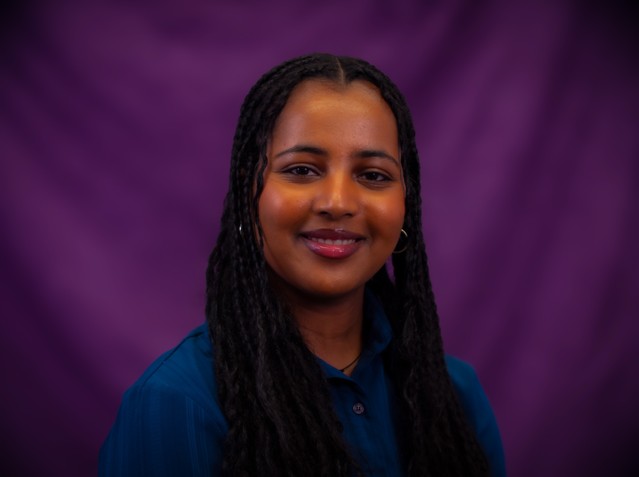
Delina Mesfin Berhe is a UW School of Nursing BSN student and one of the center’s 2025–2026 Healthy Aging Scholars. Her project is on “Exploring Factors Associated with the Use of Physical and Chemical Restraints in Hospitalized Older Adults with Alzheimer’s Disease and Related Dementias.” Her faculty mentor is Maya Elias.
Why did you choose nursing?
Back home in Eritrea, I grew up with my grandma. She would take care of us, and I would also help take care of her as she got older. When I turned 14, my siblings and I moved to Ethiopia and lived in a refugee camp for about a year. We didn’t have doctors there, so nurses were the ones taking care of most of the cases. I got the opportunity to shadow one of the nurses. I just asked if I could carry her things and walk around with her, and she said yes.
When we later moved to the U.S., nurses were also the ones helping us, especially with our language barriers. They helped us with our medical needs, like vaccines and checkups, before starting school. Seeing that made me realize that nursing is the same everywhere; it’s about caring for people, no matter where they are.
In high school, during my senior year, I joined a CNA program and fell in love with it. I started working in memory care, and every day kept me grounded. I felt really happy being able to take care of people and see them smile.
What did you like about working in memory care as a CNA?
I liked a lot about it. A lot of the patients that I had couldn’t remember anything, so every day is like a reset. I like seeing their pictures from when they were younger. I love hearing stories about their lives. It was really interesting, and I learned a lot. It was also fulfilling to see that they had lived full lives.
What interests you about healthy aging?
I can see myself working with the aging population. It’s rooted in my grandma. Every time I see an older person, it reminds me of her.
Also, I worked with children, specifically those with cancer and blood disorders, but I just couldn’t do it. With kids, it was hard for me because they’re just starting their lives and haven’t experienced everything the world has to offer. Working with older adults, I feel so happy hearing their stories; they’re laughing, and they’ve lived their lives, and many of them have kids and grandkids they’re proud of. It just feels really meaningful to me.
Could you briefly describe your scholarship project?
We’re going to explore the factors associated with the use of physical and chemical restraints in hospitalized older adults with Alzheimer’s disease and related dementias. When these patients are admitted to the hospital, they can sometimes seem really agitated, especially because of the new environment and unfamiliar people. Because of this, staff may give medications to help calm them down or use physical restraints.
Sometimes, if a family member is present, they can help calm the patient or help them listen. But many patients coming from memory care, or those with dementia, don’t have anyone in the hospital to advocate for them. People may not always listen to them, especially if they have Alzheimer’s disease, speak a different language or are experiencing delirium, and may assume they don’t know what they’re saying. This can lead to increased use of chemical and physical restraints.
In our project, we’re trying to understand what factors are associated with the use of restraints and how patients differ in terms of how much they receive, such as medication doses or the number of hours spent in physical restraints.
Why is this work and this project important to do?
It’s really important to me, and it’s close to my heart. I’ve seen how people who speak other languages can be mistreated, and how their behavior can be seen as agitation when they’re actually just trying to communicate. My mentor even told me that when reviewing charts, it can be really emotional, and it’s okay to feel that. Seeing patients without someone to advocate for them is hard. I don’t want this to keep happening in the future, so I’m hoping this project can help, even in a small way.
Is there anything else you would like to share?
I am so grateful to God and St. Mary for allowing me to have this opportunity and for being with me every single step of the way. They have helped me become who I am today. I’m also grateful for my family for encouraging me to pursue higher education, and because of that, I feel like I’ve developed a heart to truly see and care for people.
I’ve become more grateful since I started nursing school. I’m glad that knowing English now has paid off, and I can see myself advocating more in the future. This project has given me a lot of joy, being able to help families in the future.
Being able to work with Dr. Maya is one of my biggest achievements. When I got matched, I didn’t know who I would get matched with. When I met her, she’s a sweetheart. She’s always listening. She will ask, “What did you notice in their chart?” I’m grateful to have someone like that.