Skip to content

Scholar Spotlight: Mariyam Arifova

Mariyam Arifova is a first year BSN student. During winter quarter in 2020, she traveled to Japan as part of the Keio University Short-Term Nursing and Medical Care Studies Program to learn about challenges of an aging society. UW students attending the program were supported by the Center for Global Health Nursing and the de Tornyay Center for Healthy Aging.

All interviews have been edited for length and clarity.

Find all scholar spotlight interviews here.

Why did you choose nursing?

When I was in middle school, my mom was very sick. Home visit nurses used to come every day. I saw exactly what the nurses did and watched them with curiosity. That was when I first became interested in this profession. At that time, I was a kid and wanted to be a nurse just for my mom. Growing up, I learned more about my religion’s morality and realized that since all people are creatures of God, I have to love and help everybody.

In high school, I was deciding between nursing and being an interpreter, as I was passionate about learning new languages and using the three languages that I spoke. I went to Kazakhstan to visit my aunt and four cousins, who were also nurses, and they told me a lot about nursing. They inspired me to fulfill my childhood dream.

I’m also passionate about biology — human anatomy is my favorite class — and I like to work with people, so nursing is the best fit for me.

How has your experience at nursing helped with your career trajectory?

I am learning all the essential knowledge and skills that a nurse needs to work in the world. I’m very excited about my future clinicals, and the BSN rural immersion program in Montesano that I am participating in this summer. I am sure these new experiences will open up new nursing paths that I may get interested in.

What’s been an unforgettable experience during your time at the school of nursing?

The school of nursing provides a lot of opportunities for the students to find their path in nursing. I was very fortunate to go to Tokyo, Japan, for Keio University’s 2020 Short Term Nursing and Medical Care Program to learn about and discuss challenges for an aging society. I studied Japan’s aging population, went to the robocare center, did home nursing visits, shadowed nurses in Keio Hospital, and learned about nursing home models present in Japan. The experience gave me a lot of new ideas, skills, and knowledge that I will apply in my future nursing career and increased my interest in aging.

What interested you about this program?

I am a CNA in a nursing home, and I enjoy working with older adults. My goal is to run my own nursing home. Japan has a growing elderly population and high life expectancy, so I thought I could learn something from them to implement in my nursing home model.

Why are you interested in healthy aging?

As a CNA, I really it enjoy when I see the grateful faces of my residents and see how they appreciate me for being their caregiver. I also love building meaningful relationships with my residents. They share a lot of personal stories, and I learn from their life experience. Each shift, I make a difference in their daily lives. That inspires me to serve older adults as a future nurse.

Why do you want to start your own nursing home?

I feel like there are some changes that I can make to the nursing home models in the United States to improve them. First of all, I want to emphasize post-stroke patients because I personally know the challenges that stroke patients and their families face. My father had a stroke two years ago, and my grandmother passed away after her third stroke a couple of months ago. I also believe by incorporating elements from care models in other countries with an aging population, like Japan, I can provide better preventive care. I would also like to import technology and equipment that makes caring for the elderly safer and more effective.

What was the most interesting experience of your trip?

I went to Japan hoping to see how they use robots in healthcare. And I was very lucky to actually go to a robocare center and see patients using the technology for rehabilitation and communication. There are robots that can help people who lost function in their legs after strokes or other diseases move their legs so they can learn to walk again. They also have an assist suit to help caregivers, like CNAs, lift patients without hurting their back, or to help patients who are unable to stand up or sit down by themselves. I was fortunate to actually try it. I lifted different weights while wearing the assist suit and without it – it definitely helped me lift heavy weights easily.

Did anything surprise you while you were there?

We had nursing students from Japan, the UK, and South Korea. One difference that surprised me is that physical restraint, limiting the freedom of movement of patients, is illegal in the UK, but allowed in Japan, South Korea, and US. In the UK only sedatives are allowed to control movement or behavior of a patient. After discussing ethical concerns and fundamental human rights with the mental health nurses from the UK, I realized that physical restraint alternatives might be a better way to provide safe and quality care.

What was the most interesting thing you learned?

A new model of nursing home. They have nursing homes where residents live together with caregivers and the caregiver’s families. It was interesting because I had never seen a nursing home like that. They showed us videos of older adult residents cooking traditional food together with small kids and teaching them. I think it can be an ideal approach to aging for some older adults because it has a home environment and the assistance that a typical nursing home provides.

What are your plans after graduation?

I plan to spend a few years of my nursing career as a travel nurse. My main goal is to work and volunteer in rural areas of both the USA and third world countries, caring for underserved populations and improving nursing care. After that, I want to work with older adults and eventually run my own nursing home. I want to get a graduate degree from UW, but I have not decided yet if I want to go straight to grad school or work for a few years and come back.
Scholar Spotlight: Kuan-Ching Wu

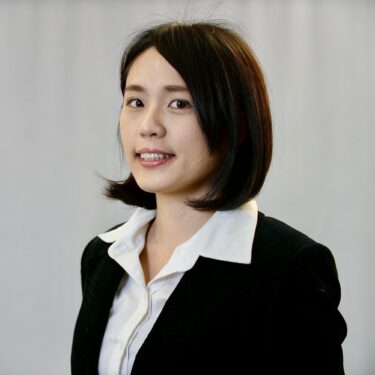
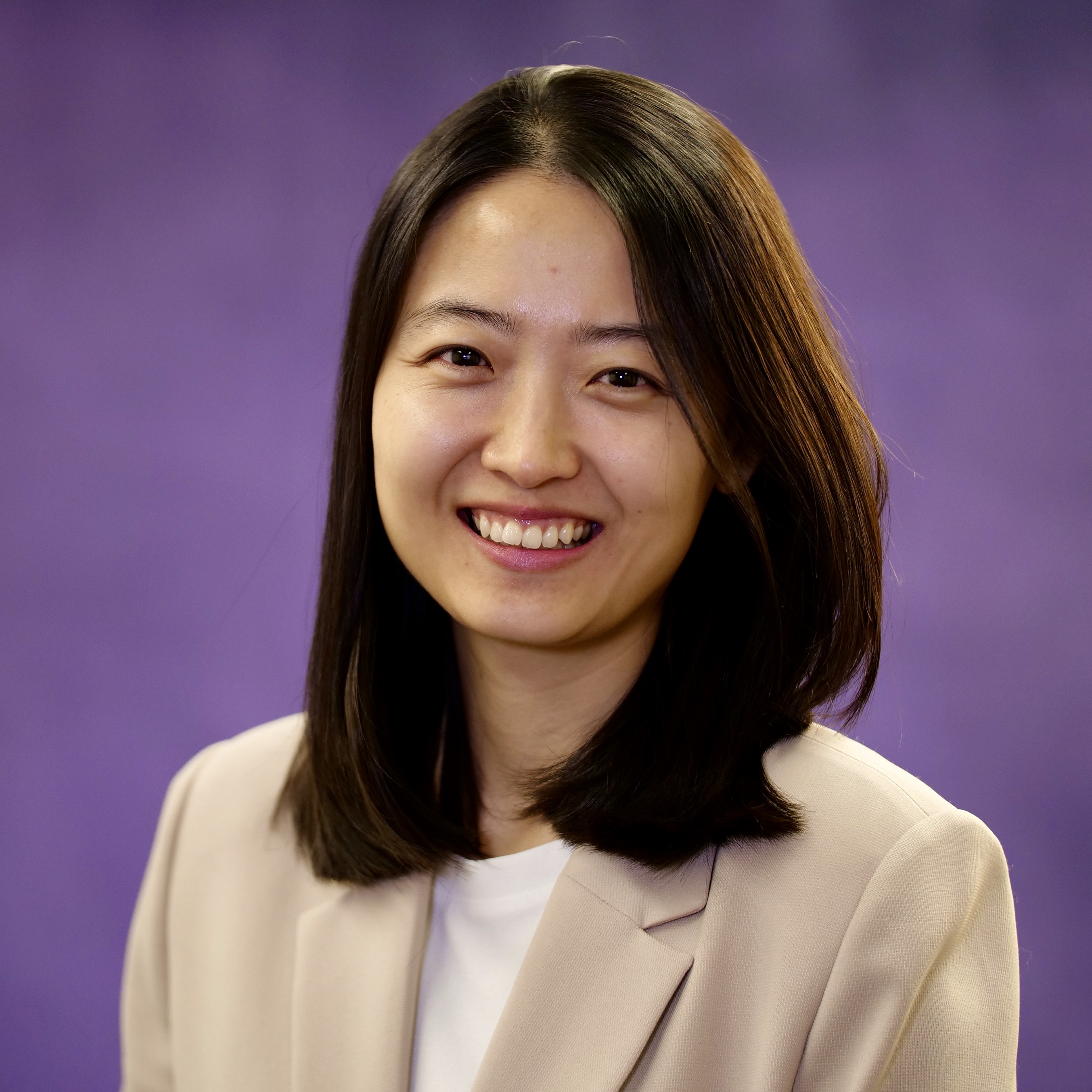
Kuan-Ching Wu, BSN, RN, is the de Tornyay Center for Healthy Aging’s pre-doctoral scholar. A first year PhD student from Taiwan, her research interests include older adults with dementia and their caregivers. Her faculty mentor is Tatiana Sadak.
All interviews have been edited for length and clarity.

Find all scholar spotlight interviews here.

2022 Update: The center is pleased to announce Kuan-Ching Wu as one of the center’s 2022-2023 Healthy Aging Scholars. Her project is on “A theoretical framework for urinary tract infection prevention and management in community-dwelling older persons with dementia” and her faculty mentor is Oleg Zaslavsky PhD, MHA, RN.

What interests you about the healthy aging field and research?

In my country, we have a countdown to becoming a super aged society. So in the next six years, when you walk down the street one out of five people will be over 65. We have low birth rates, so there will not be enough caregivers. The population with dementia cannot take care of themselves if their condition is really serious. This lack of caregivers, especially for people with dementia is the reason why I’m interested in caregivers and dementia.

Before you came to PhD program, did you have experience working with older adults or in aging research?

I worked for two and a half years in the emergency room in a medical center in Taiwan. I saw a lot of older adult patients every day. There are a lot of aging patients that need help, but there aren’t enough resources for caring for them, so that’s why I wanted to study gerontology. They are experienced, they have more stories than you. It’s pretty interesting working with them.

What research are you working on?

We’re doing research bringing together the literature on resilience from the caregivers’ perspective. We have a lot of literature about resilience for caregivers from the academic perspective, but we do not know how those caregivers think about resilience. Resilience is an important ability for caregivers to maintain their own health.

What is resilience?

Resilience is humans’ natural ability to bounce back and recover from negative events. It‘s associated with better health and well-being in caregivers so if we can improve resilience in caregivers, it will help them reduce their psychological symptoms and physiological symptoms.

I learned about resilience while I was in my first quarter of my PhD program. While the concept of caregiver resilience is highly discussed and studied across a variety of disciplines and countries including Taiwan, the most important piece of the puzzle is missing—the voices and the perceptions from the caregivers themselves. So I am interested in finding out how caregivers of patient with dementia think about this issue.

Why is this work important?

There aren’t a lot of perspectives on resilience from caregivers. There are a lot of papers about how we as nursing scholars think about resilience. Other academic disciplines also have different definitions on resilience in caregivers.

There’s one paper doing pilot research studies on caregivers’ perspective and they found that most of the caregivers didn’t have a clear definition of resilience, so that’s why I’m thinking of doing it from their perspective. If we have a more general view from the caregivers’ perspective we can know what they really think is important, not only from our scholar’s perspective. If we know what it is they consider important in resilience, we can do further interventions for them more specific to their needs.

Why did you choose nursing?

I like something practical where I can put all my knowledge into practice. I found nursing is the kind of discipline where I can put what I learn into practice. Nursing is really meaningful for me, because even when I’m working in the ER, I can see every day that what I do is helping other people to get better.

What has been an unforgettable experience during your time at the School of Nursing?

There are two. The first one is the event held by the de Tornyay Center for Healthy Aging fall quarter. The Ignite Aging symposium is really interesting because the center held a lecture for the community and they attended the lecture and learned something. And the musical interludes between lectures helped create a positive atmosphere.

I also think studying abroad is a really special experience. UW has offered us a lot of resources and everybody is really friendly here. In my class, there are only two international students, me and another Korean friend. It’s not our native language, so it’s pretty hard but we always tell each other, we can do it.

How has your experience helped you with your career?

I have a really special opportunity here in the de Tornyay Center as a pre-doctoral scholar. I have certain projects to do, like conducting a literature review with a team. It’s really tough, but it’s helped me to have more training. I think I’ll learn a lot.

What are your plans after you graduate?

I plan to stay here after I graduate, about five years, learn more about what I’m doing and publish. Maybe I will apply to post-doctoral researcher positions or to jobs in universities or medical centers. I hope to deliver research that can benefit aging populations and their caregivers, especially Chinese-Americans and Asian immigrants here — people who have similar cultural backgrounds — so I can help them with my bilingual experience. After that, I think I’m looking forward to going back to my country, promoting health care, building optimal health services for adult geriatric patients in Taiwan, and maybe working in the Ministry of Health and Welfare or finding a job at a large medical center.

Scholar Spotlight: Julia Meno

Julia Meno is a first year BSN student. During winter quarter in 2020, she traveled to Japan as part of the Keio University Short-Term Nursing and Medical Care Studies Program to learn about challenges of an aging society. UW students attending the program were supported by the Center for Global Health Nursing and the de Tornyay Center for Healthy Aging.

All interviews have been edited for length and clarity.

Find all scholar spotlight interviews here.

Why did you choose nursing?

Many people say it’s because they want to take care of others, and that’s definitely true for me too. But I was really inspired to become a nurse because of the health inequities in Guam, which my family has directly experienced. I’ve always wanted to go into healthcare to try to mitigate those barriers and be part of a system where I can have an impact.

How has your experience at nursing helped you with your career trajectory?

There are so many networking opportunities! I feel humble to be in this program because I’m learning so much from my peers. It’s exciting because everyone’s not coming in with the exact same background, so we constantly collaborate with one another and with the faculty, too. The faculty are so supportive of us, and very approachable, which has been helpful because the program can feel very stressful and intimidating.

What’s been an unforgettable experience during your time at the school of nursing?

The Keio University Short-Term Nursing and Medical Care Studies Program.

What interested you about the Keio University program?

The exchange program sounded really awesome because I was interested in learned about Japan’s “super-aging society”. I did a Japanese language immersion program in Seattle from kindergarten through eighth grade, but I’ve lost touch with my language skills. And there’s a lot of cultural similarities that Japan has to Guam, where my dad is from. I thought this would be a great opportunity to hone into these parts of my identity again while learning about a global health concern.

What interests you about healthy aging?

I have experience at an assisted living facility in Los Angeles, and the population that we were serving was affluent and white. I was forced to think about how other people are getting care at this age. I also think about my family in Guam, where there aren’t very many resources for the elderly population because most people take care of their elderly from home. But it’s important to have those resources, and I’ve always had that in the back of my mind. So I was excited learn more about healthy aging in this program and see how Japan is doing it.

What did you learn about how they’re doing it?

We got to see a traditional nursing home. Similar to the U.S., there’s a lot of resources provided in assisted living facilities, but it’s very expensive. We also saw how in-patient care works at the Keio Hospital.

But the best thing I saw was the home nursing station. The way the system is organized seems to optimize very compassionate care. The nurses see about four patients a day in the surrounding neighborhood, and they bike to each of their homes. I was really impressed with the way that the nurses took care of the adults and promoted their independence and dignity. I think the culture definitely influences that too. The way Japanese nurses show respect for their elders was apparent as soon as we walked in the house.

In Japanese culture, when you enter someone’s home, you bow to your superiors, which elders are considered to be. The nurse had a full assessment and health interview with one of her patients, and it was a lot more conversational and respectful. The patient was included in their care and had input in conversations about how they can improve their health, instead of the nurse just coming in to their space and having a set care plan.

Did anything surprise you while you were there?

The nurses in Japan have a seven to one nurse to patient ratio, which is more than the average here. There were also little things that I noticed were done differently but are not necessarily bad practices. For example, the patient beds at Keio Hospital were extremely low to the ground. I asked the nurse about why that is, and she said it’s mainly for fall risk purposes but also it simulates the futon mattress, which is the traditional mattress in Japan. But because it’s so low to the ground, I saw the nurse have to crouch over to insert an IV. There are also four beds to one patient room, which I don’t think is typical here either. Overall, they were mostly small differences but definitely noticeable.

What was your previous experience working with older adults like?

I was a CNA at an assisted living facility and they would typically assign me to just one person for the whole shift, but sometimes I would float and be with many different residents. I had great interactions and relationships with the residents there. I liked that the facility tried to format their care so that the residents weren’t overwhelmed with so many new caregivers all the time. It was exciting to get to know the residents and learn new things about them so I could incorporate it into how I took care of them.

What are your plans after graduation?

I’m still thinking about where I want to live, but as of right now I’m interested in getting a nursing job in pediatrics and seeing where that takes me.

Anything else?

I would definitely recommend this exchange program to any BSN or ABSN student. I heard a lot of people were not interested because of the unfortunate timing of the program. It was a stressful time to leave school, but completely worth it. I made some great friends from Korea, UK and Japan, and I intend to keep in touch with them.

Highlights from Dr. Kate Lorig’s Talk

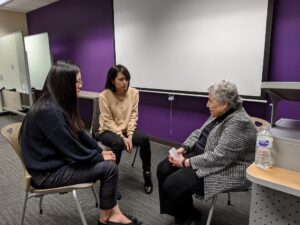
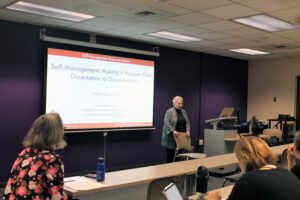
Lorig talks to a graduate student and post-doctoral fellow after her talk.

Over half of adults in the U.S. have a chronic disease, according to the CDC. Symptom self-management can be a key part of helping people with chronic diseases live a healthy and longer life.

“I don’t look at self-management so much as a theory, rather as something someone does,” said Dr. Kate Lorig, partner at the Self-Management Resource Center and professor emerita at Stanford University, in her February 6 talk at the UW School of Nursing.

Lorig walked the audience through her career developing self-management programs, from her dissertation to the current day, highlighting the groundbreaking work she has done and sharing her insights on navigating the world of research and academia.

Lorig prefers the Institute of Medicine’s 2014 definition of self-management, which defines it as “Tasks that individuals must undertake to live with one or more chronic conditions. Tasks include having confidence to deal with medical management, role management, and emotional management of their conditions.”

The management programs she developed involve groups of people meeting regularly with a facilitator and creating their own action plans for how they want to manage their chronic diseases.

“We never tell anyone what to do,” Lorig said. “Every class someone is doing something different.”

For her dissertation, Lorig developed an arthritis self-management program, hypothesizing that improving knowledge and behaviors would improve participants’ health. However, while there were improvements, the statistics didn’t show a strong benefit of the program – the improvements didn’t seem connected and may have been due to chance. But, encouraged by her mentors, she stuck with the work and eventually it paid off.

Since then, the programs she’s developed have shown success across numerous chronic diseases, improving participants’ energy levels, depression levels, self-rated health, and reducing the days they spent in the hospital. That last one is key, Lorig said, as showing lower health care usage can help get research translated into policy.

Lorig emphasized the importance of “thinking outside the box, but not too far outside the box” for researchers. Stick with novel research, but work within the system. Make studies that can be replicated and pick outcomes that policymakers care about. Know what major funders and organizations in the field are looking for and collaborate with people who know the field well.
When she and her team ventured into diabetes management, they knew early on it would be controversial. So they worked with a respected person in the field, the former president of the American Diabetes Association, who contributed her extensive knowledge and wisdom about diabetes research to help them develop and gain support for the program in the diabetes health community.

“If you’re going to leap into the firestorm, have a friend,” Lorig said.

During her talk, Lorig also shared advice that the de Tornyay Center for Healthy Aging’s namesake and benefactor, Dr. Rheba de Tornyay, once gave her about the secret to success: ask people what their problems are, reflect back to them what you heard, and carry a briefcase.

Scholar Spotlight: Catherine Munene

Catherine Munene, CCRN, PCCN, BSN, is the de Tornyay Center’s Myrene C. McAninch Doctoral Scholar. A third year DNP student, her project is looking at falls in the outpatient setting. Her faculty mentor is Hilaire Thompson.

All interviews have been edited for length and clarity.

Find all scholar spotlight interviews here.


Why did you choose nursing?

Initially, I was going to study computer science, but most of my relatives and friends here were in healthcare. They told me it was a rewarding and fulfilling field and suggested that I should try it out. I decided to take a CNA [Certified Nursing Assistant] class, and then I started working in a nursing home. And that’s when I realized, maybe this is something I really need to be doing. I enjoyed working with the elderly. I later went to LPN [Licensed Practical Nursing] school, then RN [Registered Nurse], and here I am now.


What interests you about working with older adults?

We’re all heading there, you know. What’s better than to help people age gracefully? If I can be a part of that, that’s what I want to do. Taking care of the elderly is really something I’m passionate about.


How did your experience working with older adults help shape your career?

I’ve worked in the nursing home, first as a CNA for four years, then an LPN for three years. Once I got my RN license, I worked in the nursing home for a year, and that’s when I decided to transition into adult critical care. My background in the nursing home is really a good foundation for where I’m at right now. My healthcare career has been mainly with the elderly, and I’m still doing it all these years later. It’s something that I’ve found to be close to my heart. When I was in Kenya, I used to help take care of my grandma too. When I visited Kenya a few years back, she had really changed from how she used to be. She was very frail and with my experience as a nursing assistant, it was easy for me to take care of her when I was there. I feel comfortable taking care of older adults and the decision to pursue adult gerontology NP [Nurse Practitioner] degree was easy.


What has been an unforgettable experience during your time at the School of Nursing?

The most interesting thing so far is clinicals. You learn all these things in class, but until you apply it, nothing really makes sense, for me at least. It’s been enjoyable going to different hospitals and clinics. We’ve been learning all these things about being a nurse practitioner, and then going out there having a clinical experience with providers, it’s been really rewarding.


How has your experience at the school helped you with your career trajectory?

Everything really, because if I didn’t go through this training, I wouldn’t know what to do when I’m out there. I know what to do as a nurse, but not as a nurse practitioner. So the foundation is being laid down in the school of nursing. All the clinical labs and the teaching in the classroom are preparing me to be a confident and efficient provider.


What are your plans after you graduate?

I would want to continue working with older adults. Cardiology and infectious disease are areas that I’m really interested in. Two very different specialties, but very close to my heart.


What’s your research project in the de Tornyay Center?

It’s about fall prevention in ambulatory care settings with a local healthcare organization. They had 308 falls in the last year in all their facilities. I’ll be looking at that to find out what are the contributing risk factors for all the falls. Once I find the area with the most falls, I’ll focus on that area and recommend evidence-based tools to help prevent more falls from happening and reduce harm related to falls.


What interested you about this project?

Falls happen everywhere. They happen in hospitals, at home and in clinics. Although there are many resources available to help prevent falls, falls continue to happen and result in high mortality and morbidity. I want to look at what the research shows regarding fall prevention in the outpatient settings because a lot of the studies that have been done are more inpatient focused. I want to see what’s causing the falls and what’s out there on toolkits that can be used in the outpatient setting.


Why is this project important?

Bottom line, prevent falls in the elderly. People are living longer and fall risk increases with age. For instance, a 65-year-old person who lives to be 90 years old experiences a fall at 65 and ends up wheelchair bound. That can result in worse quality of life, lack of independence and isolation. Falls are preventable. We can play a role in preventing falls and improve quality of life for older adults.

Scholar Spotlight: Kristi Louthan

Kristi Louthan is the de Tornyay Center’s Germaine Krysan Undergraduate Scholar. An ABSN student, her research project looks at lifestyle factors and dementia in Asian American older adults. Her faculty mentor is Basia Belza.

All interviews have been edited for length and clarity.

Find all scholar spotlight interviews here.


What research or practice areas are you interested in?

What I really love and am passionate about is kinesiology, so the movement of the body, and actually trying to fix physical problems as naturally as is possible. I was initially interested in going into chiropractic work, then differed into Emergency Medical Services, EMS, and then through that found my love toward nursing. The body is something I’m passionate about.


Why did you choose nursing?

I’ve gone through a few different careers. But a few years ago, I sat down and said, nursing might be something I’m interested in. I had seen myself being pushed and drawn toward it throughout the last years in my medical careers. EMS has always been my main drive, I’ve been a firefighter, EMT, ambulance worker, ER tech, and a few other jobs with dialysis and a detox treatment facility.

I was in the ER working right underneath nurses and physicians and able to see what exactly nurses in the ER do. After seeing nursing in that realm, I knew I was going to be very happy doing this. That was my final deciding factor.

I always am trying to push myself and be open to learning new skills and new traits, techniques and knowledge in general. Nursing was definitely something I saw myself going after and wanting to pursue, so the ABSN program was the fastest way to do that and made the most sense for me. It works out perfectly timewise. It’s like it was meant to be.


What is your research project with the de Tornyay Center?

The focus is on Asian Americans and dementia and Alzheimer’s associated diseases. I’m going to be a subset of the study, asking a couple of questions directly related to the active lifestyle of the individual throughout their life and what effect does that have on dementia and other Alzheimer’s associated diseases.


How did you find the research project?

It was the first week of school, I was trying to find a room, and I was looking lost. Basia Belza, a professor, was walking by, and she showed me how to get there. In the discussion we had in the stairway, she mentioned her specialty in geriatrics care and movement, and I said it was something I was interested in. She said if you’re interested in a research program, come to me.

When I sat back and thought about it, research would be kind of fun. In my undergrad, I didn’t really do anything research specific. Now’s the time to get my foot wet. When I had a sit down with her, she proposed the research program through a couple of her graduate students and said if you want, you could do a subset directly related to kinesiology and movement in the Asian American population. I said yes, sign me up.


Why is this project important?

Living to an older age is increasingly common. There are a lot of people impacted by dementia and Alzheimer’s and all the other progressive diseases. It’s so unfortunate, they might be able to be physically functioning fine, but their mental abilities are impaired, and it takes away from them being able to have the best quality of life. And as we live longer, it’s just going to become a bigger aspect that we need to pay attention to.


What interests you in working with older adults?

One thing would be I’m just not interested in pediatrics. Older adults, they can make changes, they can have direct impacts on their health. They have the choice. In my first undergrad, I started volunteering with hospice, and it opened me up toward the medical side of working with older populations.


What has been an unforgettable experience during your time at the school of nursing?

I’ve been pleasantly surprised at how open and willing everyone is in this department to support you getting to where it is that you want. It’s a stressful program, but it blew me away, having everyone behind your back, helping you so much to get to the end goal.


How has your experience at nursing helped you with your career trajectory?

My goal as a future healthcare professional is to try to work diligently as a team member, and a future leader, to create a pathway for better quality of life for the patients and for a healthcare system that struggles with limited resources and increased costs of care. My background education is in kinesiology, a focus on movement, development, and maintenance of the body, and my passion is healthy living, through a collaboration of physical, mental, and emotional health, and simple objectives such as diet, sleep, and hydration. Completing the ABSN program will help me reach my goal of becoming a nurse for both my love of medical practice, along with my own personal love related to this idea of overall health.


What are your plans after graduation?

ER work is what I’m most interested in, but I’ll see what specialty I’m more drawn to. It might be something totally off the wall, but we’ll see.

Scholar Spotlight: Isadora Yi

Isadora Yi, BSN, MN, RN, is one of the de Tornyay Center’s Healthy Aging Doctoral Scholars. A DNP student, her project is creating a dementia care toolkit. Her faculty mentor is Hilaire Thompson.

All interviews have been edited for length and clarity.

Find all scholar spotlight interviews here.


When did you realize you wanted to work in gerontology?

I’ve always enjoyed working with my older patients but didn’t realize that this was my niche until I did a clinical rotation in a post-acute care setting this summer. It was the first time I woke up excited to go to clinicals. That quarter went by so fast.

And there aren’t enough geriatric specialized providers, especially with the rapid growth of the older adult population. There are many things that you really need to consider in geriatrics, like ­the types of medications to avoid, dosage changes, and the different ways illnesses present in older adults — just to name a few.


What did you like about your summer rotation?

I liked that I could spend a longer time with them versus internal medicine, where you only have around 15 minutes. The time allowed me to really get to know them, their family, and their stories. I got to learn who they were and not just their body and their diagnosis. That’s what I really enjoyed. I got to see the whole person, all of them.


What is your project with the de Tornyay Center?

My project title explains it, it’s ‘Creating a Dementia Care Toolkit for Caregiving Staff in the Memory Care Units’, with a local senior living community company. The caregiving staff, they provide the most care for adults there with a dementia diagnosis. It’s 24-hour care, yet the staff has the lowest opportunities for education, especially in dementia care. Dementia care is so complex, and it’s really difficult for the organizations to pull them off the floors and offer them training on the side. The agency and I were talking about it and thought we could create an on-site resource for them to give them some on-site support, and they could use it as an educational tool.


Why did you choose this DNP project?

I had an opportunity to do some of my rotation at a walk-in clinic at one of this company’s communities during my first clinical rotation, and I just loved it. The residents and staff are so nice, and the atmosphere is warm, and the cherry on top is working with the 65 plus age group. They are so kind, fun, and wise. And then this summer, I was at another one of their communities and enjoyed the rotation there, too. So when I saw their name come up in our list of projects, it was my first pick.

I have two memory care units that I’ll be working with, and one of them happened to be the first floor of where I was during the summer, so I knew most of the staff there. It’s like I’m going back home.


What interests you about the project?

I am interested in dementia care. One of the risk factors for dementia is age, and if I work in geriatrics, I’m definitely going to see a lot more of it.


Why did you choose nursing?

I would like to say that nursing chose me, but I think my grandmother laid down the first steppingstone. I spent a lot of time at the university hospital as a child because my grandmother was diagnosed with cancer. I remember thinking the physicians looked so cool in their white coats, and the nurses were so kind to my grandmother. I knew I wanted to work in the medical field. My first job was in cancer research, in the exact same university hospital my grandmother was treated in.

And then life happened, and I was in California. I had all this passion and energy, and I needed to do something. I saw a sign for a community college near my home, not knowing that it was one of the top-ranking community college RN [Registered Nursing] programs in Southern California at the time. The average wait is one to two years, but I got in the first time, three months after I applied.

To be honest, it started out as ‘maybe I can do something on the side’. Then I got into it and realized nurses do so much more than I thought and most people probably see. It’s really changed me. Nursing taught me empathy and brought more humanism into me. I see the world in color now versus just black and white.


How has your experience at the school of nursing help with your career path?

It’s given me opportunities to learn about the different sectors of nursing, something I wouldn’t be able to do alone because no one in my family has a health care background. I’m a first-generation college grad, so navigating academia has been a little challenging in various ways. The faculty has helped me to spread my wings in a safe space while giving me guidance when I need it.


What has been an unforgettable experience during your time at the School of Nursing?

Meeting intelligent, independent, and confident women who are also motivated to advance their skills and knowledge to help others. I made many new friends that I have so much respect for and look to for support. I never felt like I fit in until I met these great people. We cheer each other on, celebrate the good, and push through the not so good. They helped me find my voice and have continuously pushed me to become a better version of myself.


What are your plans after graduation?

Between March and graduation in June, I’ll be prepping for and taking my boards. I also have a big trip coming up. It’s become a Korean tradition for children to send their parents on an overseas trip for their 60th birthday, so I plan on taking my parents on a trip somewhere in Europe after graduation.  It will be their first time in Europe!

Scholar Spotlight: Boeun Kim


Boeun Kim, BSN, MSN, RN, is one of the de Tornyay Center’s 2019-2020 Healthy Aging Doctoral Scholars. A fourth year PhD student, her project looks at cognitive health and the walkable neighborhood. Her faculty mentor is Basia Belza.

All interviews have been edited for length and clarity.

Find all scholar spotlight interviews here.


Why did you choose nursing?

When I was 10 years old, I lost my grandfather. He was injured in a car accident and had severe brain injuries. After a long stay in intensive care, he was sent home, but he never fully recovered. He was not able to communicate, move, or eat independently. He passed away two years after the accident. We all had to learn to deal with our grief. The impact of brain health on my whole family has forever been imprinted on my mind. When I was a high school student, I was looking for ‘what should I do’ and I found nursing. I thought a nurse can support sick people and volunteer for those who cannot access health care for reasons like financial issues. I could have a job, and at the same time I could help other people.


Why are you interested in the field of healthy aging?

While I was working at a cancer center, I met a lot of older adults who were struggling with diseases. I met a few older adults who didn’t have sufficient information and resources to deal with their health issues. I saw how much health status could impact the quality of life in older adults. I wanted to help promote older adults’ health and expand their healthy years.


Before you came to PhD program, did you have experience working with older adults or in aging research?

I worked for the Active and Healthy Aging Project for two and a half years. The intervention consisted of health education and exercise to support healthy aging for older adults living in the community. I also worked for another research project exploring the behavioral and psychological symptoms in people with dementia in long-term care facilities in East Asia, including China, Japan, Korea, Taiwan, and Thailand.


What made you realize you wanted to do research?

I met Dr. Susie Kim, who inspired me to pursue research. She was a retired professor at the Ewha Womans University’s School of Nursing in South Korea. After retiring, she traveled to Malawi in Africa where she led a nursing and midwifery school. I saw the immediate impacts on communities made by her research and leadership. I observed how a person can make the world a better place to live.


What is your research project?

My research project focuses on how walkable neighborhoods can support cognitive health in older adults. Particularly, I am examining the association between walkable neighborhoods and cognitive function and dementia. I will also explore if there are discrepancies between the objectively and subjectively measured neighborhood’s attributes and if those discrepancies are associated with the cognitive outcomes. This project can help develop interventions and policies to change neighborhoods so that they better support cognitive health.


How did you originally find this research project?

I read an article saying poor neighborhood socioeconomic status is associated with worse cognitive function in older adults. But conventional interventions mostly focus on individual factors such as improving motivation and knowledge. I thought we also needed to address environmental factors like neighborhood environments, but there was not much research on neighborhoods’ impacts on cognitive health. That’s why I decided to conduct this research, to add evidence in this significant field.


Why is the research project important?

The aging population is growing and the number of people with dementia is expected to grow as well. There are limited pharmacological treatments for dementia so prevention is the best treatment. Walkable neighborhoods may help improve cognitive health through stimulating brain activity and by promoting physical activities.


What has been an unforgettable experience during your time at the School of Nursing?

There are a lot of unforgettable moments at the School of Nursing, such as when I passed the general exam, when I received an award at Western Institute of Nursing annual conference and when I first published an article. The best thing that I have done at the School of Nursing is meeting a great mentor. I have faced a lot of challenges, but I can successfully finish the last three years because of support from faculty members, family, and colleagues. Without their help, I could not be here.


How has your experience at the School of Nursing helped you with your career trajectory?

I learned a lot of knowledge and research skills from research projects and my course work, which are essential to building my career. However, I cannot learn all the knowledge that I need from courses. The more important skill is learning how to approach a problem I have never seen before. The key thing that I have learned from my mentor and the PhD program is how I can approach new problems and where I can find resources to help solve those problems.


What are your plans after graduation?

I plan to apply for a post-doctoral position in healthy aging and neighborhood environments field and then keep developing my career in this field. I want to continue to conduct research to improve cognitive health in older adults.

NINR Director’s Lecture Recording

On November 19th the de Tornyay Center held a screening of the National Institute of Nursing Research Director’s Lecture ‘Informing Health Policy Through Science to Improve Healthcare for Older Adults’ by Patricia Stone, PhD, RN, FAAN.

Stone’s research aims to enhance the quality of care for older adults including preventing healthcare-associated infection and improving infection management and end-of-life care. Her program of research has contributed to policy changes, such as state and federal legislative mandates that hospitals report infections.

Couldn’t make it? Find the lecture recording here.

2019 – 2020 Healthy Aging Scholars Announced

The de Tornyay Center for Healthy Aging is pleased to announce the 2019-2020 Healthy Aging Scholarship recipients.

There were a limited number of scholarships available.  We extend our thanks and high regard to all who applied.  Scholarship recipients receive funds and support for research projects related to healthy aging and older adults.  We look forward to hearing the results of their work at the Nurses of Influence Banquet on April 30, 2020.

Please join us in congratulating these exceptional scholars and their faculty mentors!


PhD RESEARCH SCHOLARSHIP:

Boeun Kim, Healthy Aging Doctoral Scholar

Topic:  Walkable Neighborhoods and Cognitive Health in Older Adults

Faculty Mentor:  Basia Belza, PhD, RN, FAAN


DNP RESEARCH SCHOLARSHIPS:

Catherine Munene, Myrene C. McAninch Doctoral Scholar

Topic:  Fall Prevention and Harm Reduction in Ambulatory Settings at a Local Health Care Organization

Faculty Mentor:  Hilaire Thompson, PhD, RN, CNRN, ACNP-BC, FAAN


Isadora Yi, Healthy Aging Doctoral Scholar

Topic:  Developing a Dementia Care Toolkit for Caregiving Staff in Memory Care Units at a Local Retirement Community Company

Faculty Mentor:  Hilaire Thompson, PhD, RN, CNRN, ACNP-BC, FAAN


UNDERGRADUATE RESEARCH SCHOLARSHIP:

Kristi Louthan, Germaine Krysan Undergraduate Scholar

Topic:  Aging Counseling and Referral Service (ACRS) Dementia Project

Faculty Mentor:  Basia Belza, PhD, RN, FAAN

Highlights From Ignite Aging 2019

The Ignite Aging Symposium is an annual event hosted by the de Tornyay Center for Healthy Aging, featuring a sampler of outstanding healthy aging research by University of Washington School of Nursing faculty, students and alumni. Each speaker gets five minutes to present their work, followed by a question and answer session.

Presenter Azita Emami with guest Ethlyn McQueen-Gibson from Hampton University, Virginia.

Below are highlights of the Ignite Aging symposium from September 27, 2019. Or, view 2020 Ignite Aging here.

Kicking off with Executive Dean Azita Emami on the potential of music to help individuals with dementia and their caregivers, the program was interspersed with music performed by several student musicians. Music has proven to have great potential in reducing agitation and improving communication in people with dementia. Emami is investigating music’s potential in reducing caregiver stress.

PhD in Nursing Science student, Yan Su, presented her analysis of the blog, Engaging with Aging, written by 97 year old retired nursing faculty. Her analysis of the blog identified major themes including discussion of age-related changes and how the blogger responded to those changes. Over 18 months of writing the blog, the author seemed to gain insight into her experiences and derive pleasure in sharing them.

Audience members speak during a break

Our brain waves are sometimes fast or slow, depending on what we’re doing. The fast waves are conducive to hard tasks, like solving a puzzle, but slow waves are important for resting and sleep. Chronic insomnia can come from having too much of the fast waves and not enough of the slow, said Associate Professor Jean Tang. She’s developing a device to help fight insomnia, which uses light and sound to coax the brain’s activity into slow waves. The device has shown promise in pilot studies.

Poor diet is one of the leading causes of death, Assistant Professor Oleg Zaslavsky shared. Low consumption of healthy foods like whole grains, nuts and vegetables can be dangerous to your health. Previous research has identified the Mediterranean diet as having numerous health benefits. Zaslavsky and his colleagues are developing an app to help older adults follow the diet. The app will include, among other things, food and ingredient recommendations, information about the diet, and a way to talk with health care professionals.

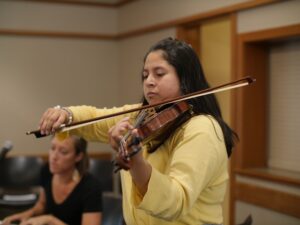
High School student Marina Sanchez performs.

Chemotherapy physically changes the body in ways that can correspond to a decade or more of aging and can lead to earlier development of chronic conditions, such as heart failure, in cancer patients. Associate Professor Kerryn Reding spoke on her team’s work, which found that the amount of fat around the organs could predict heart failure in cancer survivors, but not overall weight. Next she wants to investigate if the fat around the organs could be causing accelerated heart aging from chemotherapy.

As we age, we grow more likely to have chronic illnesses, but our detection system is getting worse. Our perception of chronic disease symptoms, like pain, fatigue and shortness of breath, decreases as we age, Post-Doctoral Fellow Jonathan Auld told the audience. Sometimes these symptoms can also be misattributed to age. Tracking symptoms and getting in tune with our bodies can help us understand what is a natural part of aging and what is worth reporting to your health care provider.

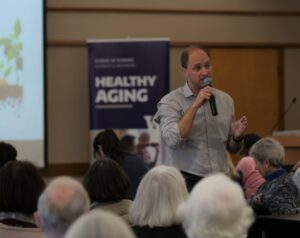
Presenter Oleg Zaslavsky speaks on nutrition.

Alumna and Clinical Faculty at Pacific Lutheran University, Kelsey Pascoe, presented her dissertation research on the barriers homeless individuals recently released from jail face in accessing health care. Inmates in jails have higher rates of many health conditions. Many individuals leave jails with unmet health needs. Pascoe found that one of the problems was these individuals have higher priorities: needs like food, housing, and clothing. There were also cost barriers, including access to the internet and a phone, and transportation to and from health care appointments, in addition to emotional concerns, such as distrust of the health care system.

Join us for our third annual Ignite Aging on Friday, October 2, 2020, over Zoom. Learn more at events.uw.edu/IgniteAging2020.

Photos by SON LIT Media Group.