For most midwestern middle school students, a class trip to Washington, D.C., stands as a rite of passage. I was in sixth grade when our school bus from Youngstown, Ohio, pulled into D.C. It was the first (and only) time I climbed the Washington Monument. The first time I read the Gettysburg Address. The first time I was awestruck by the size and power of our Capitol Building. And though I’ve been to our nation’s capital hundreds of times since that first trip – I still look forward to revisiting my favorite memorials, being inspired by our shared history in the Library of Congress and discovering new truths about our national story with each visit. These are the reasons why I was excited to take my own school-age daughters on their first trip to Washington, D.C., this past spring. While we managed to hit all the highlights, it was revisiting the National Air and Space Museum that struck me the most.
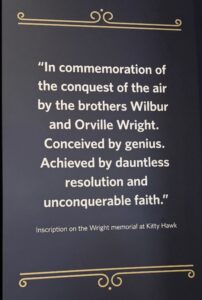
It’s been more than 30 years since I last visited this particular museum, and experiencing the story of Wilbur and Orville Wright was surprisingly moving. I was struck by their iterative attempts to achieve their dream of taking flight; excitement, experimentation, courage and failure. Over and over again. They tried. They failed. They learned something new. They tried again and again until December 17, 1903, when they finally found success with the first airplane in Kitty Hawk, North Carolina. Yes, this is a story of human ingenuity, teamwork and tenacity, but it’s also a story of the global communities that supported them, encouraged them and inspired them to pursue their vision of aerospace progress – not for themselves but for all humankind.
 This is my last column for the Office for Nursing Research & Innovation’s Weekly Research Roundup. As one does during transitions, I’ve reflected on why we started this newsletter, what we hope its impact has been and what that means for the future of nursing science and scholarship at the University of Washington School of Nursing.
We started this newsletter because throughout this community we saw scholars whose vision for the impact of their work was truly unlimited. We tried to lift up science that was often less visible but whose influence on the health of our most vulnerable is immense. And we wanted to build a community of scholars who recognize just how important their work is – but only if they work together, support each other and recognize one person’s success as everyone’s success.
What is often unsaid (and unprinted) is that success can only be achieved through failure, and that failure always feels personal and often isolating. Yet the story of the Wright brothers reminds us that persevering through the many failures that underpin progress requires a supportive community. In the five years I have worked at the University of Washington, I have submitted more than 30 grant proposals – most not discussed and only three funded. I have gotten some pretty scathing course evaluations. I have had abstracts rejected from important meetings and have been nominated for awards I did not receive.
With each failure, members of this community – faculty, staff, students, alumni and friends have supported me. With every cup of coffee shared, revision read, lunch initiated, flower gifted, every word of encouragement, walk accompanied, authentic conversation had and every happy hour we gathered at – you have supported me and reminded me that dreaming dauntlessly is why we get into this business. Higher education is largely centered on the practice of envisioning how our world can be better in both big and small ways across generations. At our best we are not only dreamers but also dream builders, working to help the seemingly impossible take flight. The crux of this work lies in our support of each other, our students and our community to envision a better future for all. The full embrace and support of this community in my pursuit of some truly audacious dreams over the past five years has changed me – for good.
As I prepare to transition to the University of Michigan, I hope that you will permit me one final request. This business is becoming increasingly tough. There are pressures to produce more students, articles, grants, new programs, revenue streams and there are dwindling resources. The value of our work faces increasing scrutiny from decision makers unfamiliar with and hostile to higher education. Tensions and divisions continue to grow. Tribalism and competition are a natural, albeit base human response to change and perceived scarcity; but they are not inevitable. My ask is that you support each other. Grow together. Treat the work and weight of the mission with seriousness but try not to take the failures personally. Dream together. Have fun. Help each other be the people you got into this business to be. If you can do this, I have no doubt that this community will emerge stronger than ever – changing all of us not just for good, but for the better.
Until we meet again, friends – A.