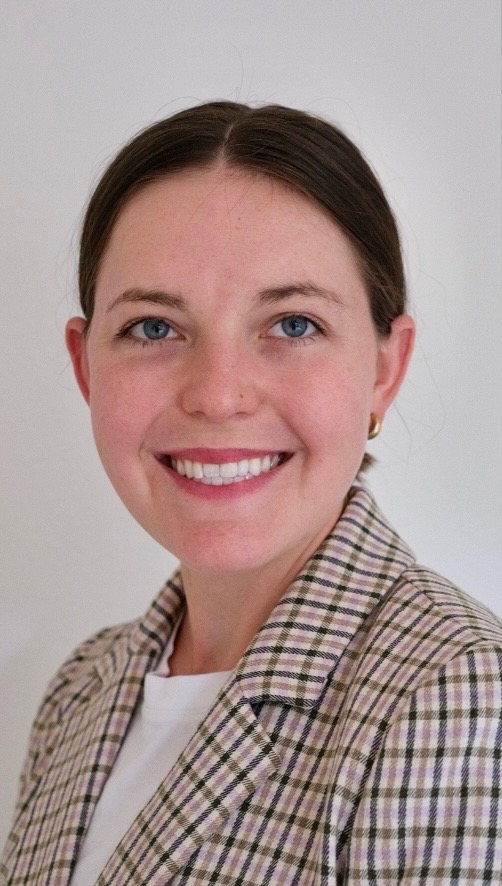
Li Downs is a DNP student and one of the de Tornyay Center’s 2025–2026 Healthy Aging Scholars. Her project is on “Enhancing Education on Post-Intensive Care Syndrome: A Nurse-Led Quality Improvement Initiative in the Neuroscience Intensive Care Unit at Harborview Medical Center” and her mentors are Maya Elias and Kristine McGlennen.
Why did you choose nursing?
It’s one of the most trusted professions in the United States, and I wanted to make an impact in people’s lives. I always had a science-based mind, and I was really interested in human anatomy. My aunt was a nurse, and my grandfather was a doctor who were both inspiring and great role models for me. As I grew up, I was more drawn to the role that nurses have in healthcare and the impact that they have on patients’ experiences while in the hospital.
What interests you about healthy aging and working with older adults in general?
I am very interested in working with the older population, and not just because we have an aging population. Older adults have so much wisdom, so when you’re caring for them, you’re learning from them and their life experience.
I initially wanted to be in pediatrics because my aunt was in pediatrics. Then, when I started doing my rotations, I enjoyed talking to the people that reminded me of my grandparents. I felt like I could identify with them better.
As I got into my nursing career, you start to see trends, especially in the older population, of things that you could work to prevent or have better outcomes. Falls is the big one that I think of that you can do a lot of education and community engagement to prevent. There’s a lot of areas in medicine and community engagement where you can help older adults, make a big impact and prevent worse outcomes.
What drew you to getting your DNP?
During COVID I was very inspired by the nurse practitioners I worked with and how they stepped up to help fill the gaps that we were having in patient care. Watching them command a room, make decisions and drive the management plans inspired me to want to be in that role and be able to step up.
Also, the DNP program gives you the resources to make systemic change in a healthcare system. It helped me feel like I was better prepared to be a leader in the healthcare system. I was actually doing a quality improvement project the year before I applied to the DNP program. The impact of that project really inspired me to apply because I felt like I could do more of it with this degree and have a bigger impact on how we change our care policies.
Could you briefly describe what your project is on for your de Tornyay Center scholarship?
The point of this project, and specifically the section that I’m focusing on with the de Tornyay Center, is providing post-intensive care education to nursing staff and advanced practice providers about inpatient interventions to prevent post-intensive care syndrome.
Post-intensive care syndrome is this syndrome that develops in ICU survivors, and it has a physical, cognitive and psychological component. The physical is the muscle wasting, the ICU-acquired myopathies. The cognitive is poor word finding, impaired executive function, difficulty concentrating and memory issues. And the psychological is depression, anxiety, post-traumatic stress disorder, sleep problems and nightmares.
This can develop in 50% to 80% of patients. It can be debilitating and can last months to years. It has a huge impact on quality of life, people’s ability to return to work, their relationships with their families and being able to walk and eat on their own.
This project is focusing on increasing education because there’s no formal education at Harborview in any of their ICUs right now. We’re focusing on the neuro-ICU because it’s a very underrepresented population in research. We’re working on increasing education through presentations, a flyer and general unit engagement.
Our hope is by educating the staff that it will help them think more critically about interventions, what they can do to prevent it and also help them talk to patients about it.
You mentioned inpatient interventions. What types of interventions are those?
A lot of it has to do with delirium prevention. The ABCDEF bundle is a researched, well-known delirium prevention checklist of things you should be thinking about and checking every day.
The bundle is early mobility; avoiding deliriogenic medications; limiting days on the ventilator; making sure you’re doing your spontaneous awakening trial and your spontaneous breathing trial; treating pain, but not over-treating people with opioids; making the ICU feel as much like home as possible, and this can be through making sure family’s at bedside, having photos on the wall, playing music; and then promoting sleep-wake cycle, like lights on during the day, lights off during the night, limiting sleep interruptions, those kinds of things.
Then, some other interventions that have evidence supporting them are ICU diaries, support groups and resiliency training for patients and family members — resilience in the sense of, how do you cope with depression, anxiety and these intense feelings of being critically ill.
Has there been anything that surprised you while doing this project or learning more about the topic?
We just closed our pre-survey to measure the baseline knowledge, engagement and confidence in the topic. I was really lucky with the amount of staff that were willing to take my pre-survey. There was a lot of engagement. We got almost 50% of participation which, when you think about asking people to do surveys, is pretty good. I was very happy with it. But people were very candid about how little they knew about the topic. I was surprised by how needed this education initiative was.