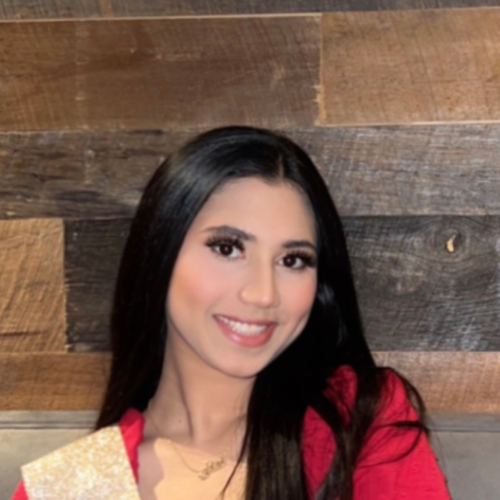
Fiza Noman is a BSN student and one of the de Tornyay Center for Healthy Aging’s 2026–2027 Healthy Aging Scholars. Her project is on “Unwrapping Bias: Addressing Ageism Towards Older Adults Alongside Racism in Nursing Textbooks to Advance Inclusive Education and Promote Healthy Aging.” Her faculty mentor is Bethany Rolfe Witham.
What made you choose nursing?
I came from Pakistan, where healthcare is not very accessible to everyone. I’ve seen people back home who have not received good healthcare, and due to that, they have suffered great loss. So, I’ve always known that I wanted to work in healthcare where I can make a difference.
Ever since moving here, I’ve been looking into professions where I’m part of healthcare and can provide direct patient care. I wanted to be hands-on, where my patients can share their experiences with me while also providing great care to them.
I started looking into nursing, and then right upon my junior year of high school, I came across UW’s Nurse Camp. That was the main exposure to nursing, and I got to learn more about the UW School of Nursing program and what the profession is like.
What interests you about healthy aging?
I spent almost four years volunteering on and off in an assisted living community. Also, my grandparents lived with me for the majority of my time growing up. I knew that I wanted to work with this population because I feel like I can connect with them well, and I want to be there for them.
I also completed an externship this past quarter. It was a long-term care externship. I got to spend some time in other assisted living communities across the Seattle area. Then I completed a quarter of modules where we talked about how care is different for the elder population in comparison to other populations. That was very interesting to me, and it further solidified my interest that this is the population that I want to work with.
How was your experience in assisted living?
I really enjoyed it because I could see how much of a difference I was making in their lives. A lot of those people didn’t have family, or they hadn’t seen their family in a while. I could see just spending a couple of minutes with them, chatting with them, how much it made their day. I saw the care that the nurses provided for them, how much it meant for them and for their lifespan as well.
I grew up taking care of my grandparents. When I provide this kind of care, I do it out of genuine empathy for these patients, and I know that I’m making a difference in their life.
What is your research project with the de Tornyay Center scholarship?
On REDCap, BSN students can submit submissions of instances of bias and ageism in their textbooks. We look at the submissions, we do data analysis, and then we can, in the end, send those results to the publishers, so they can also make those changes in the textbooks. In the past, publishers have made those changes.
I think it’s important because nursing textbooks are a main resource that you’re using towards your education, and if you’re seeing biases and ageism in it, those stay with you long-term.
Do you have any examples of ageism and bias you’ve seen?
In nursing textbooks, the language can portray older adults as very dependent. They can show aging as a bad thing, as in, if you’re aging, you’re not benefiting from it, and you’re going to depend on someone, and there’s not enough care for it.
I also saw a lot of bias towards the marginalized communities and people of color. I saw in a lot of assisted living how they’re treated differently. And in textbooks, I also saw that there’s a lot of lighter-skinned representation, especially for the older population. I think it’s important to have the textbooks also show people of color, and students have submitted instances of that as well for publishers to show more representation.
Has there been anything that surprised you while working on this project?
I thought that I would not find a lot of instances of ageism in nursing textbooks. I thought that it’s a normal process, it’s a lifespan process, and there shouldn’t be any biases around it. But once I started looking at the data, I saw there’s so many instances of ageism that students have collected over the past years. That really surprised me. Why are nursing textbooks in today’s time still showing those? I want to be part of this project so I can start working towards that change.
What interested you about getting involved with this project?
Since I’m a person of color, I look at it like people from my community might be involved in assisted living communities. I will, sometime in my future, also be involved in assisted living communities. I think it’s important to have representation of people like us.
When you go home as a student, you read through your textbooks, you learn from your textbooks. It’s valuable to see how we can make changes, so students are getting the right education, the right content, so they’re well equipped to work with all populations.