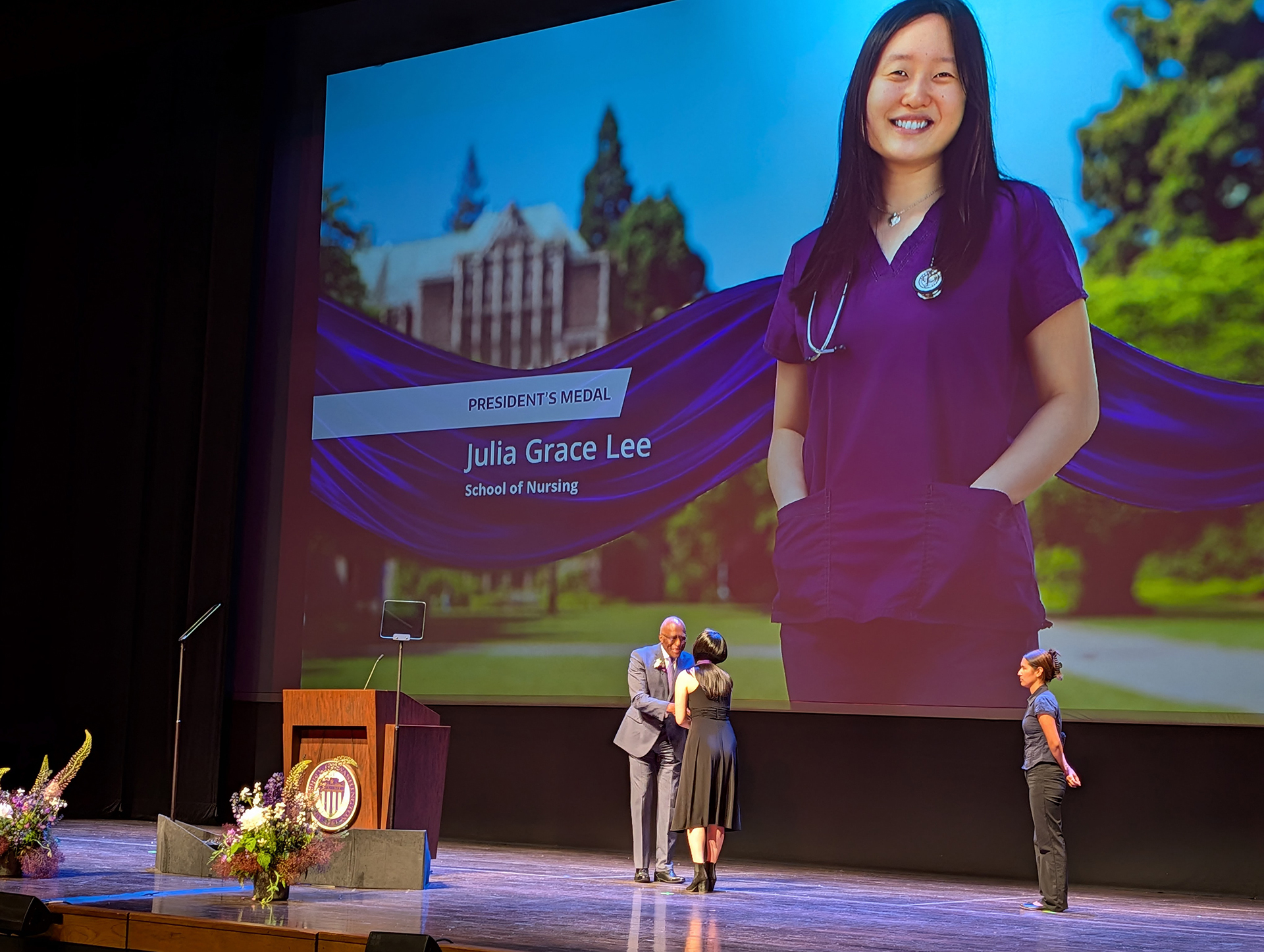
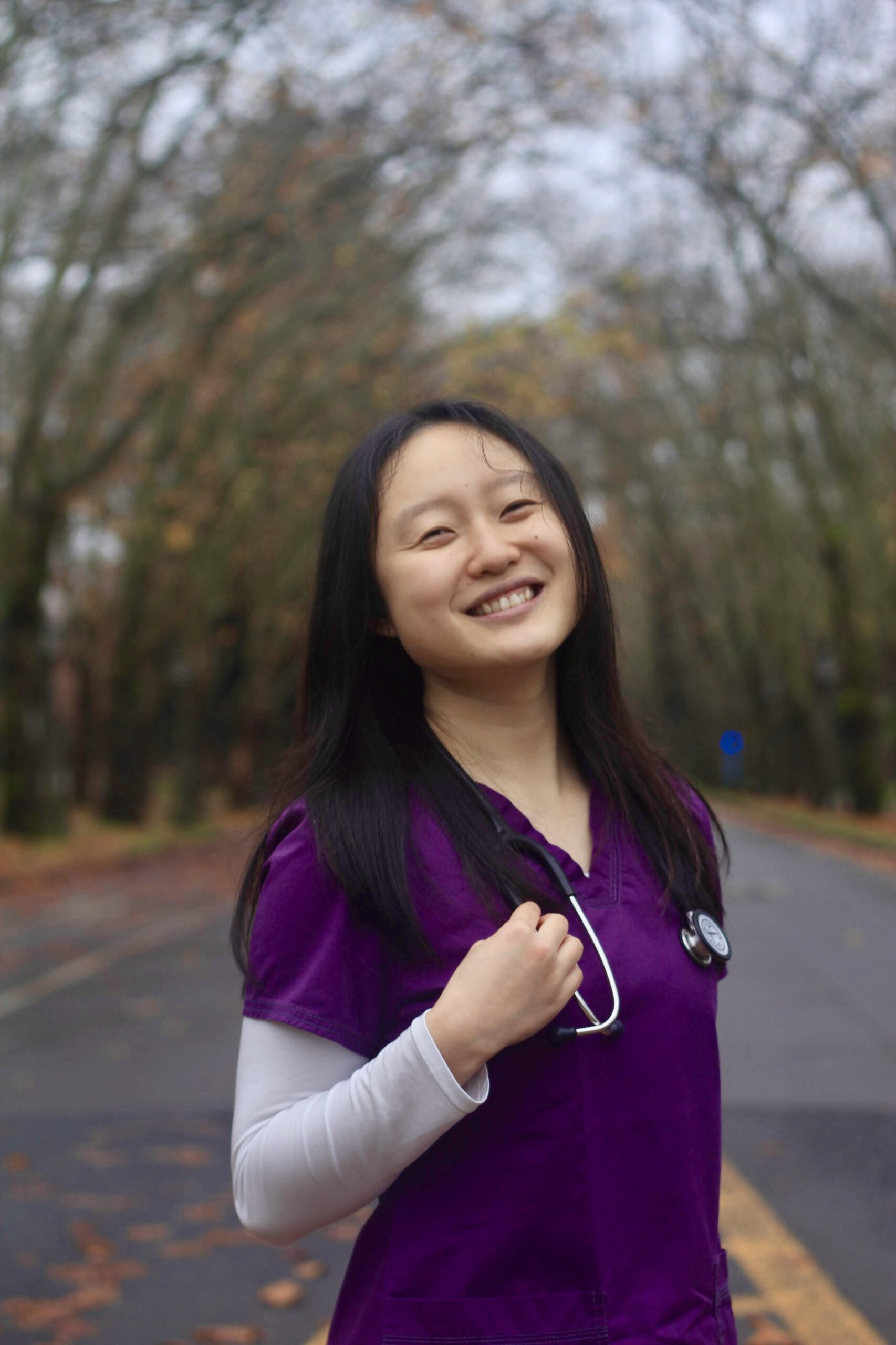
Julia Lee is a BSN student and the center’s 2025–2026 Germaine Krysan Endowed Scholar. Her mentors are Basia Belza and Sarah McKiddy, and her scholarship project is “Incorporating Dementia-Inclusive Practices to Music-Based Memory Loss Programming in a Cross-Sector Partnership.”
Why did you choose to go into nursing?
Back in high school, I was in a volunteer program at a local hospital. Volunteering in the inpatient units, I realized that nurses were the people in the care team who got to form close relationships with their patients—walking alongside them through every step of their recovery journeys. That connection and trust was what I sought and wanted to provide in my healthcare career.
Did you have a background in healthcare work before starting your BSN program?
I’ve been working as a certified nursing assistant (CNA) for the past 3 years, starting in my freshman year of college. I’ve loved all the experiences that I’ve been able to gain as a CNA. I work mainly on an inpatient acute rehab unit while also floating to neuro and cardiovascular floors throughout the hospital campus. I work with a lot of older patients there, so that’s where my interest in healthy aging research really started to develop.
What interests you about healthy aging and working with older adults?
In my childhood, I was surrounded by a lot of older adults. There’s not many people in the younger generations in my immediate family, and so I spent a lot of time with my grandparents and other older adults in my family.
My grandparents have always been role models for me in terms of healthy aging. I wish that everybody in my generation had a couple of people who could be role models of healthy aging to them, to show them that aging can be beautiful, aging can be healthy, and aging can be something that is motivating and inspirational.
Right before starting college, my grandmother had a stroke. We were told that her prognosis wasn’t the best, that recovery would be difficult considering her old age. But my grandmother has always been healthy—sometimes I’d even joke that her and my grandfather were healthier than me. She fought and persevered through rehab, and now she’s back to walking a mile every day, going out with her friends, and writing me birthday cards filled with paragraphs of her sweet words and wisdom. She is one of the kindest, smartest, healthiest people I know, and she continues to inspire me and my work every day.
Then of course, I started working in the acute rehab unit, and I was working with a lot of older people who had experienced a stroke or other neural injuries. I fell in love with the geriatric population even more. I love the older generation—their perseverance and resilience, their wisdom and rich life stories, and their kindness that shines through despite difficulty.
What’s the research project that you’re doing with the de Tornyay Center?
I’m working with PhD candidate Sarah McKiddy and Dr. Basia Belza, helping with Sarah’s dissertation creating music-based interventions for people living with dementia in the community. We are trying to establish a partnership between the Memory Hub, which is a dementia community center in Seattle, and the Seattle Chamber Music Society’s quartet-in-residence program, where a renowned quartet lives and engages with the Seattle community for 9 months. This year, the Balourdet Quartet has been living just a block away from the Memory Hub, making it a great opportunity for us to create that partnership to develop and offer music-based interventions for the people who come to the Memory Hub.
While you’ve been doing that work, has there been anything that surprised you?
The most surprising thing has been the process of doing qualitative research. I didn’t have prior knowledge about how qualitative data like interviews could be translated into the results that we get in research studies. But going through the process of transcribing focus groups, coding themes, and collaborating with different researchers to get new perspectives while eliminating bias has been really interesting to be a part of.
In terms of what I’ve been seeing in the research itself, doing this work has only confirmed the pre-existing notion that music can be really powerful—not just emotionally, but that it can be a way to possibly improve the health and quality of life of people.
What interested you about working on the project?
Aside from my interest in gerontology and healthy aging, music has always been a really big part of my life. I played violin for 8 years, my dad is a singer, and I have also sung ever since I can remember. As I’ve grown older, I’ve realized how important music is to me. It forms part of my identity, but also it has such a big impact on how happy I am.
Sarah’s dissertation really intrigued me because I wanted to see if that could be translated to medical health. I know that music is important and can be impactful, but can it be something that makes a marked and measurable health impact?
Why is this research important to do?
There’s a need for more effective interventions for people living with dementia in the community. A lot of the negative manifestations of dementia, like agitation, distress, and depression, are currently treated through medications. These medications are often ineffective and can cause a lot of unwanted side effects. Music-based interventions have shown to help relieve or improve a lot of those negative symptoms without any side effects. Music has also shown potential to slow the progression of dementia.
This research is really promising and exciting, but most of the music-based interventions that have been studied have only been in institutionalized settings like in hospitals or care facilities. Most people living with dementia live in the community still, and so we need a way to bring those music-based interventions to them. Our project is aiming to do just that.