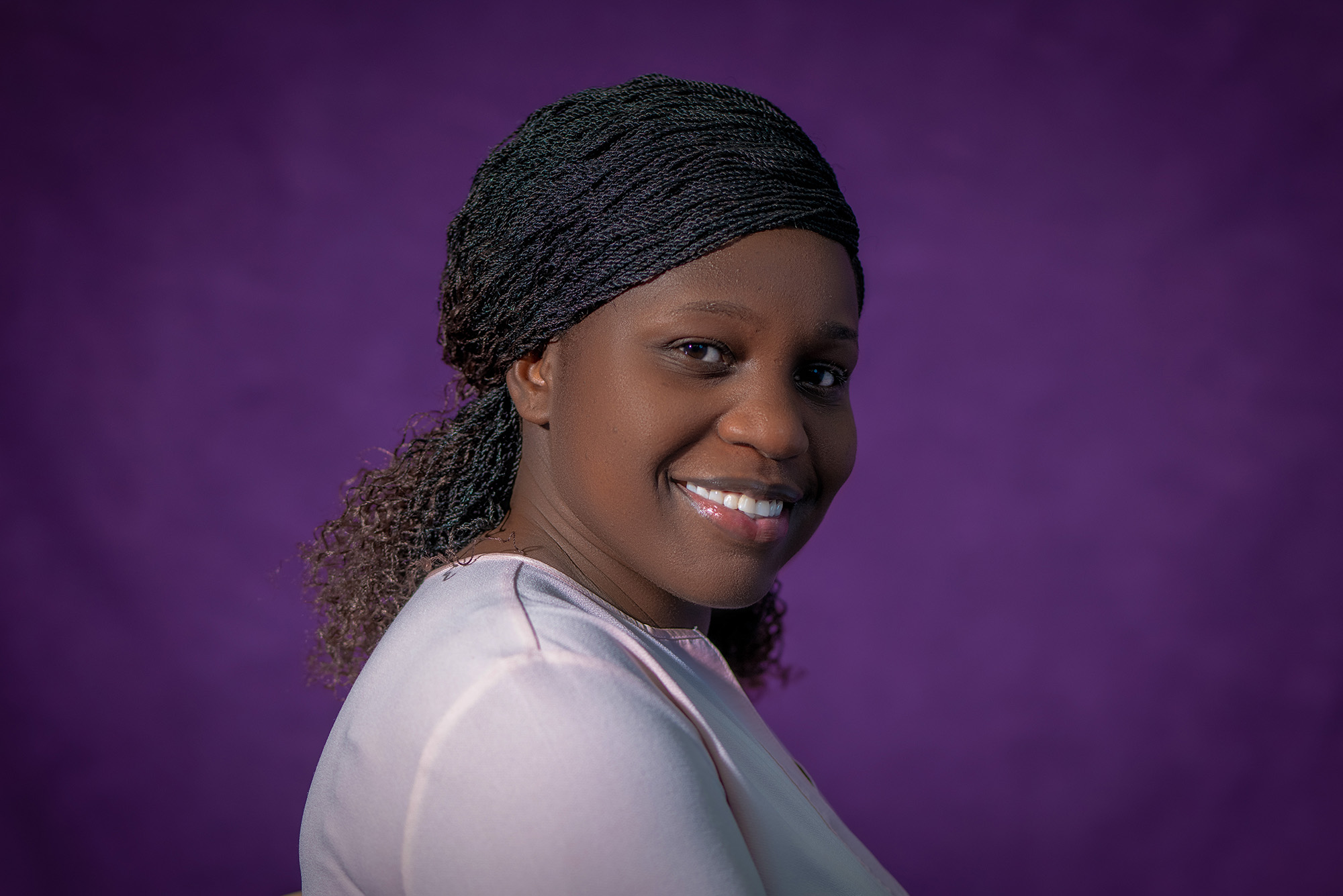
When Harriet Fridah Adhiambo first arrived at the University of Washington in September 2021, she carried with her more than just her nursing degree from Kenya—she brought a mission forged from years of witnessing the devastating impact of HIV in her home country.
“I think it has been a transformative journey for me,” reflects Adhiambo, now in the final stretch of her PhD in Nursing Science at the UW School of Nursing. Just weeks away from her dissertation defense, she looks back on four years that have reshaped her as a researcher, a clinician and a global health advocate.
Finding Purpose Through Direct Experience
Adhiambo’s path to nursing and HIV research began unexpectedly after high school when she took a position as a research assistant collecting data about tuberculosis patients in Kenyan villages.
The living conditions were dilapidated, and it really wasn’t good because some of them were not able to access medication. We had lots of mortality. You could go to a village to conduct a survey and be told, ‘We’ve lost three or four family members here because of HIV and tuberculosis.’ It was devastating.
That experience, combined with losing someone in her family during childbirth, steered her toward nursing with a specific focus: improving outcomes for people with HIV.
Building a Bridge Between Research and Care
After completing her nursing education, Adhiambo worked at a private healthcare facility where she encountered many young women, some as young as 15 or 16, who were pregnant, had young babies and were HIV positive.
I realized the gap is in health education. Some of them were not really aware of how transmission occurs, and that there was medication that someone can take to prolong life.
Taking initiative, she developed a health education plan for the facility before moving on to join a U.S. President’s Emergency Plan for AIDS Relief (PEPFAR)-funded program focusing on prevention of mother-to-child transmission services and cervical cancer screening for women living with HIV.
“It was motivating for me to offer these services because I could see how babies were thriving. You give this woman medication for the baby to prevent transmission, and at the end of nine months, they’re HIV negative,” Adhiambo says. “That was good. I got satisfaction and it was evident that the interventions were working.”
From Implementation to Innovation
After gaining hands-on experience implementing HIV care strategies, Adhiambo wanted to take the next step: designing the interventions themselves. She joined the Kenya Medical Research Institute as a study nurse, working on innovative approaches like text messaging systems and conditional cash transfers to improve HIV care engagement.
My experience working with this organization was that these interventions were working. They were working, and you could see people are being engaged in care. People are taking their medication, they’re coming to the clinic as scheduled.
It was during a short course at the UW School of Public Health that Adhiambo met Dr. Sarah Gimbel, who would later become her dissertation chair. Initially interested in pursuing a Master of Public Health, Adhiambo was encouraged to apply to the PhD in Nursing Science program instead—a decision she calls “the best I made.”
Navigating Challenges with Resilience
Adhiambo’s academic journey hasn’t been without challenges. She arrived with her husband and son, gave birth to another child during her PhD program and had to adjust to new educational technologies and approaches.
“I remember my first week, people were talking about an assignment being submitted, and I didn’t know what people were talking about,” she laughs, recalling her initial unfamiliarity with Canvas, UW’s learning management system. “By the time I’ve been told, ‘You have to log into Canvas, this is where you check,’ I was having my first assignment due that day at midnight. It was crazy.”
But Adhiambo quickly learned to navigate the system and seek support when needed. “I came to learn about it, like, things can work for you. You just need to know whom to ask. And at times, don’t be shy about your challenges as a person.”
Looking to the Future: Integrating HIV and Cancer Care
As she completes her PhD, Adhiambo is focusing on the intersection of HIV and cancer care, a critical area as people living with HIV face elevated risks for certain cancers.
I’m aiming to build a program that intersects both HIV and cancer, trying to improve outcomes of people who are having cancer but at the same time are HIV positive. If you’re HIV positive and you have cancer, what’s the best care we can give you? What strategies have worked to improve your health outcomes?
Adhiambo has been applying for postdoctoral positions that would allow her to continue this vital work, collaborating with researchers like Dr. Sarah Gimbel, Dr. Vitor Oliveira and Dr. Allison Webel on domestic HIV research while maintaining her connections to Kenya.
“What is working here that can work in my country? Because HIV is a global problem,” she emphasizes. “And also, what works in my setup that can work in the US, to just advance HIV care, aiming at reducing new infections.”
Advice for International Students
For other international students considering a similar path, Adhiambo offers encouraging advice: “There are lots of resources here. There are lots of opportunities that you can learn from, and there is opportunity for growth. The School of Nursing offers those opportunities through the resources that they have available for us.”
She emphasizes the importance of asking questions, networking and being open to learning experiences—even unpaid ones—that build skills and connections.
Feel free to ask questions. Just put yourself out there. This is what I want to do, and you’ll get all the help that you need from this department.
As she prepares for her dissertation defense and takes steps toward the next phase of her career, Adhiambo remains guided by the perspective that has brought her this far: “It’s just your attitude will get you to where you want to be. You have to see it and go for it.”
With her dedication to improving HIV care across continents and her commitment to addressing the emerging challenges of cancer in people living with HIV, Harriet Fridah Adhiambo exemplifies the global impact of UW School of Nursing scholars. She’s transforming healthcare one patient, one study and one innovation at a time.
— Jennifer Hunt